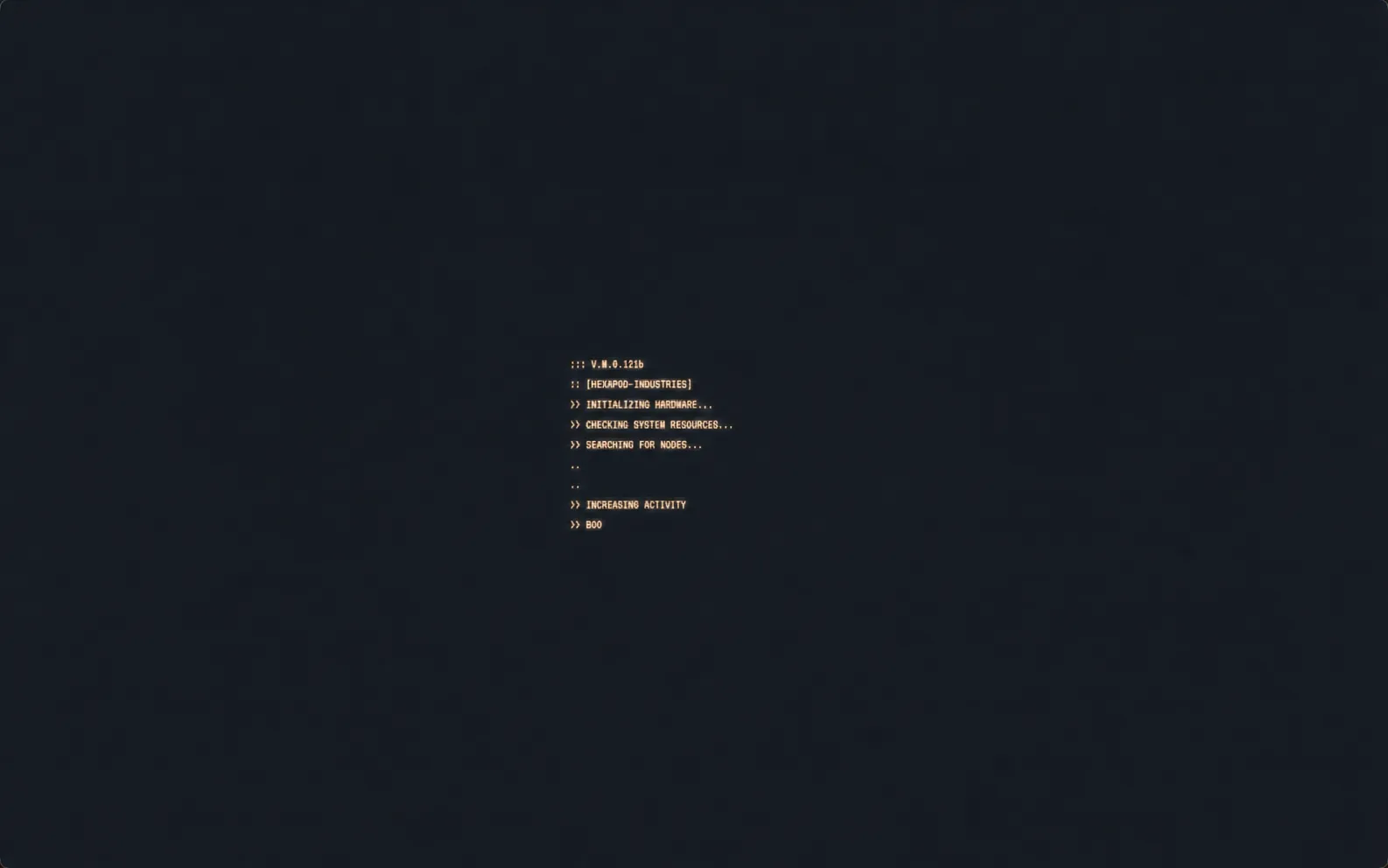
An ARG is a fictional story played out through real-world media. Players follow clues across websites, social accounts and other channels, piecing the story together through their own discoveries.
THE EXPERIENCE
Read an inbox. Find a command. Call a number hidden in plain sight. Each discovery opened another part of the story, with digital artifacts called Holofacts connecting the journey.
DESIGN & DEVELOPMENT
I created Hexapod from concept to release: the story, visual identities, interfaces, puzzles and interactive objects, along with the websites, custom phone challenge and Ethereum contracts.
THE STORY
Hexapod Industries recruited researchers to investigate Meshionics, a poorly understood energy technology. Its artifacts, called Holofacts, became the centre of a dispute over who should control it.
Mosa opened an alternative route into the research. Mythos opposed corporate control and raised a more unsettling possibility: the technology could affect perception, or reality itself.
Who gets to control a discovery nobody fully understands?
THE STORY CONTINUED ON TWITTER
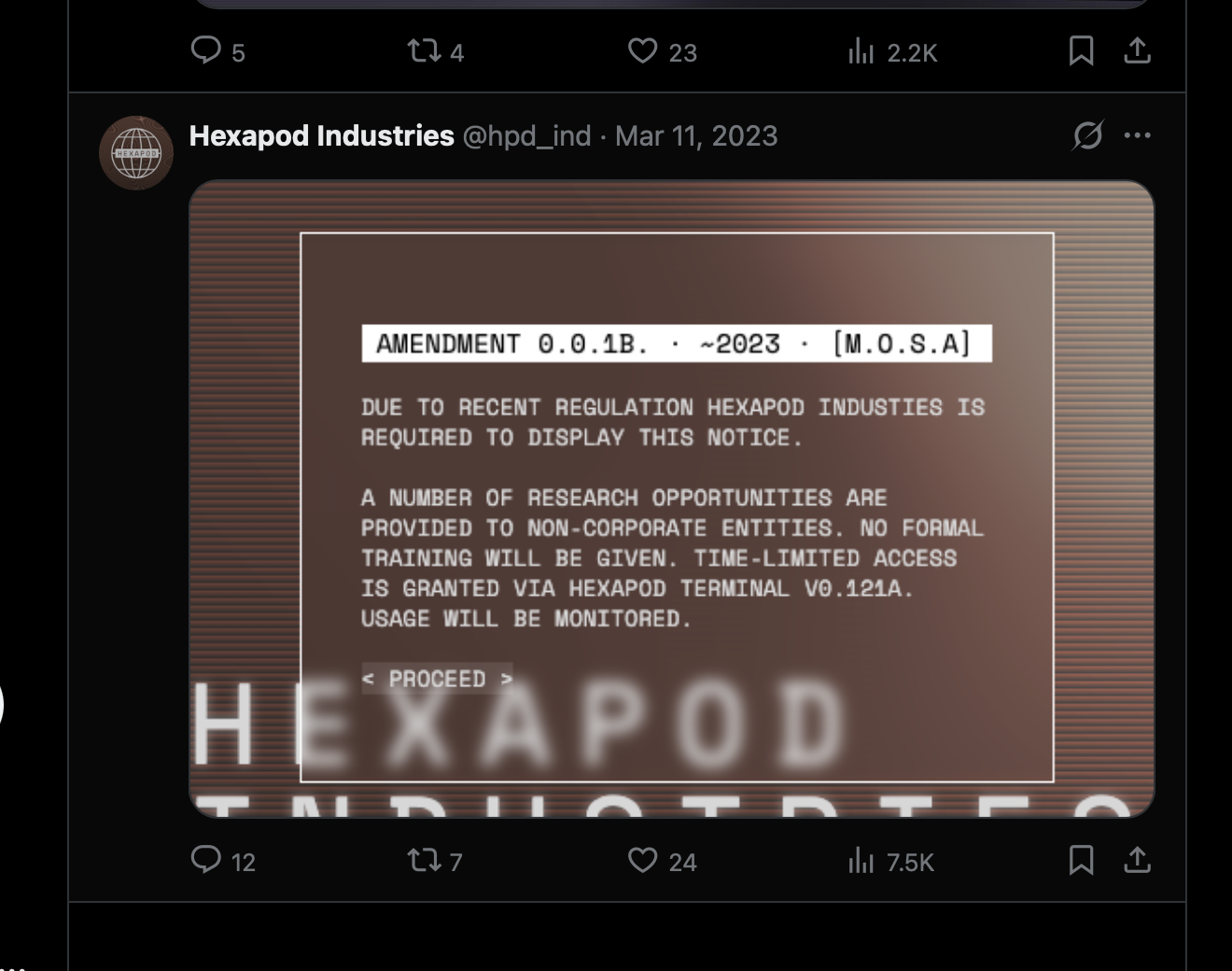
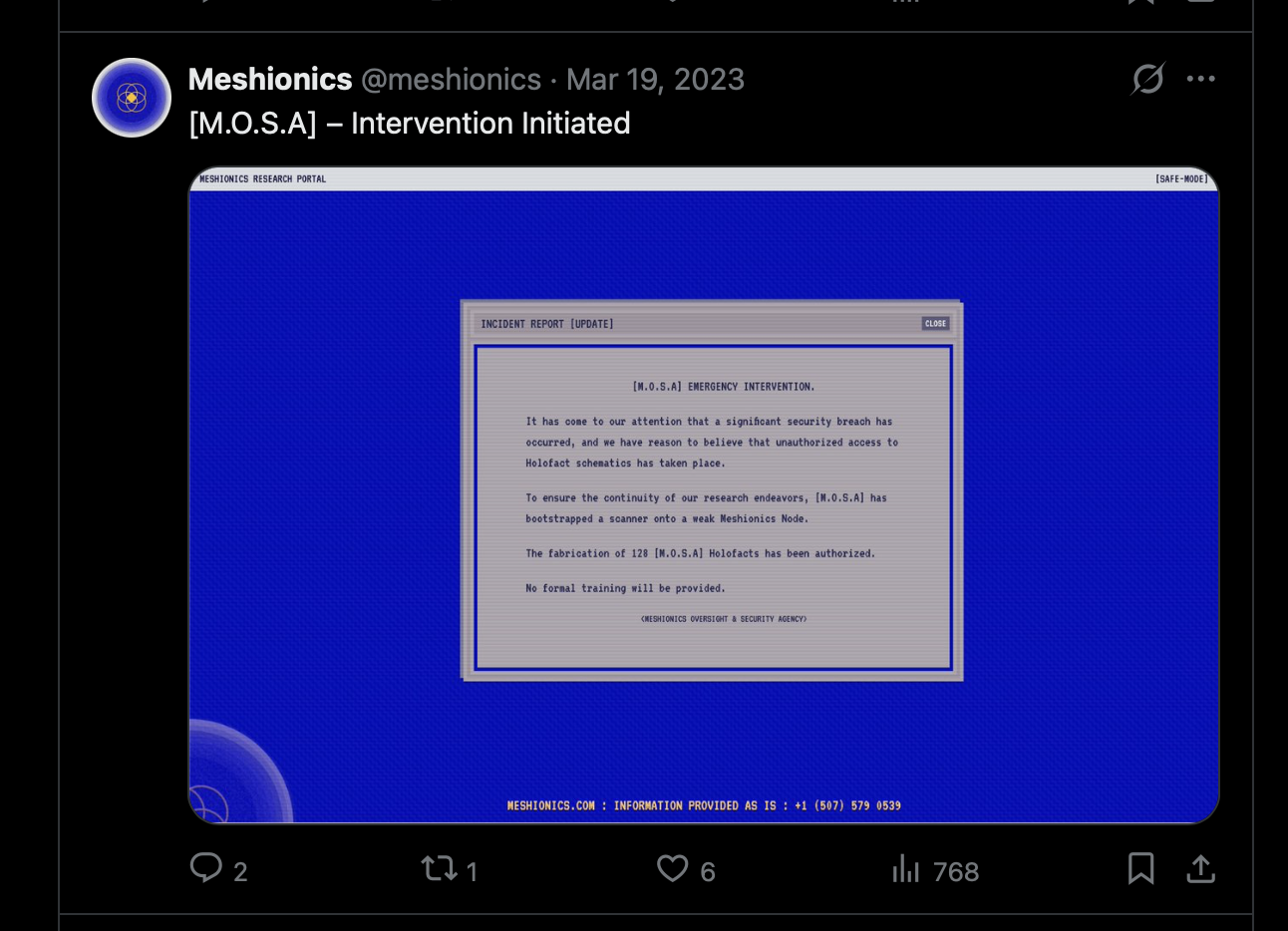
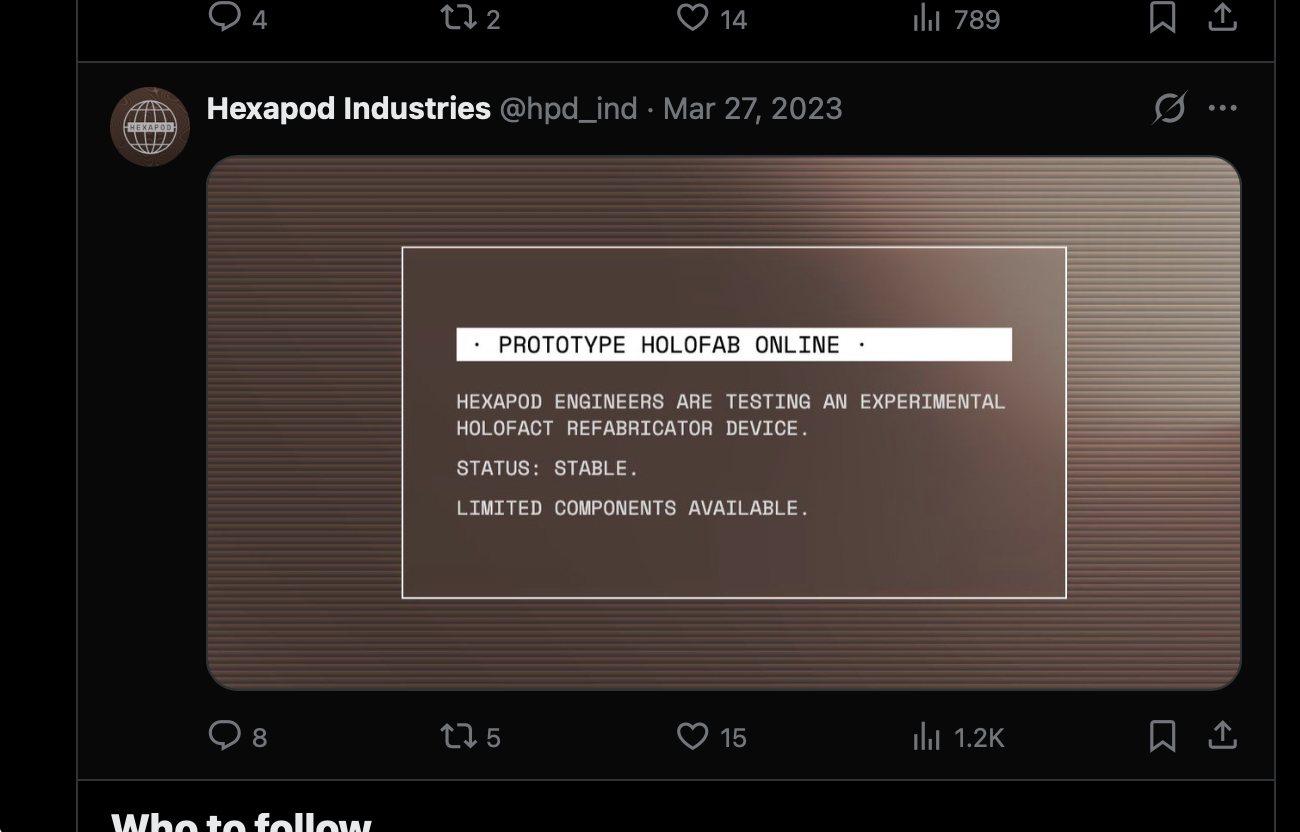
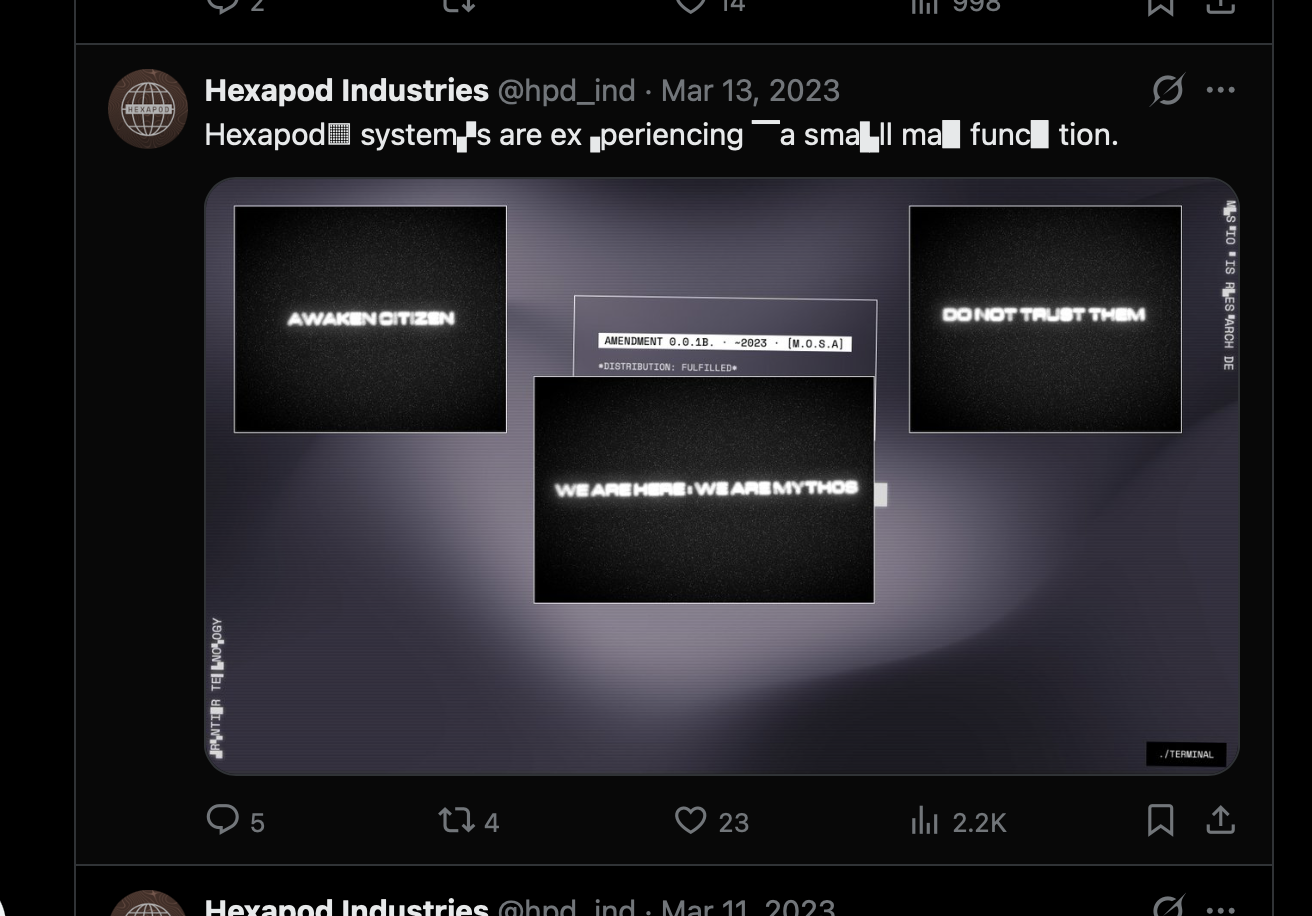
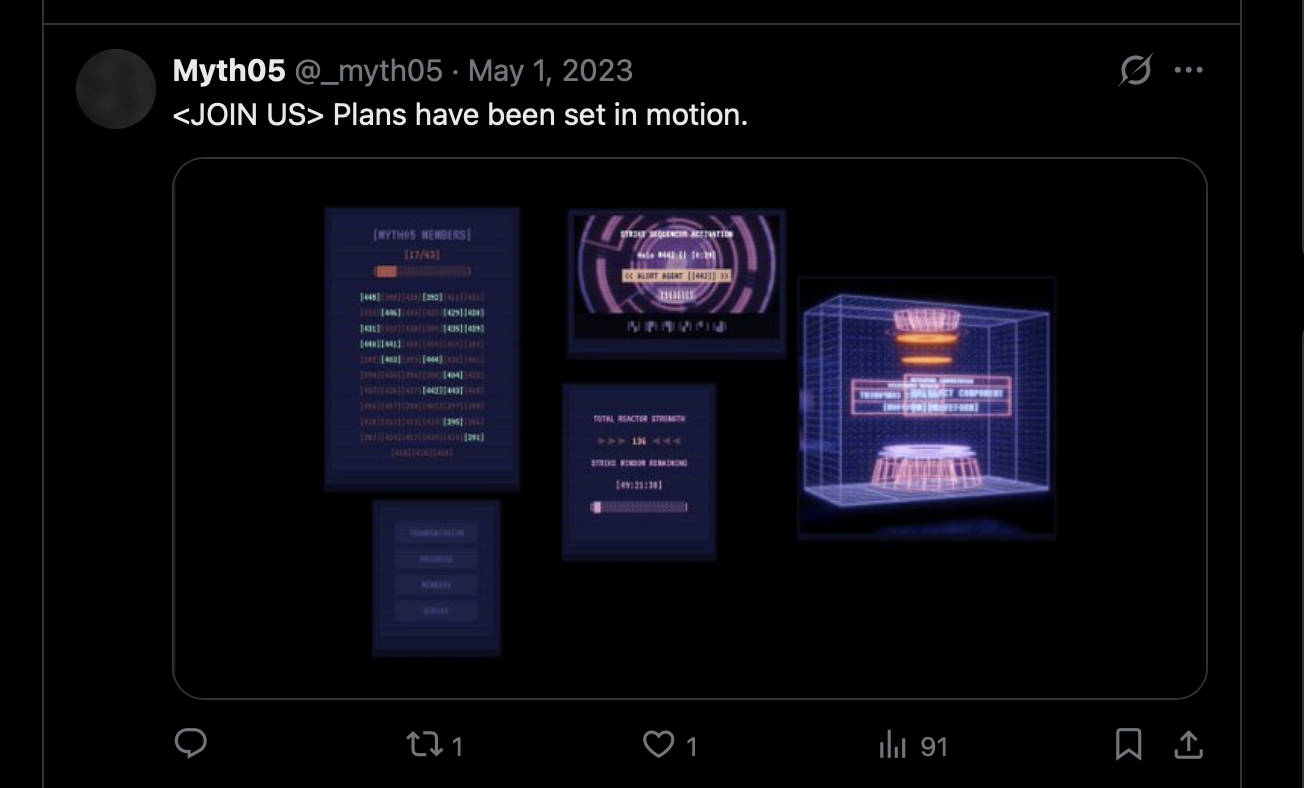
Connected faction accounts posted in character. Corporate notices, research updates and coded messages extended the events on the websites into a public conversation.
Hexapod reported malfunctions and requested researcher support. Meshionics described the aftermath of a Mythos attack. Mythos sent its agents timed and coded instructions. Following those accounts helped players connect events across the three sites.
400 Holofacts — collectible artifacts created on Ethereum. The first season ran in spring 2023. Research cards and levelling launched; the planned component factory and reconstruction systems remained unfinished.
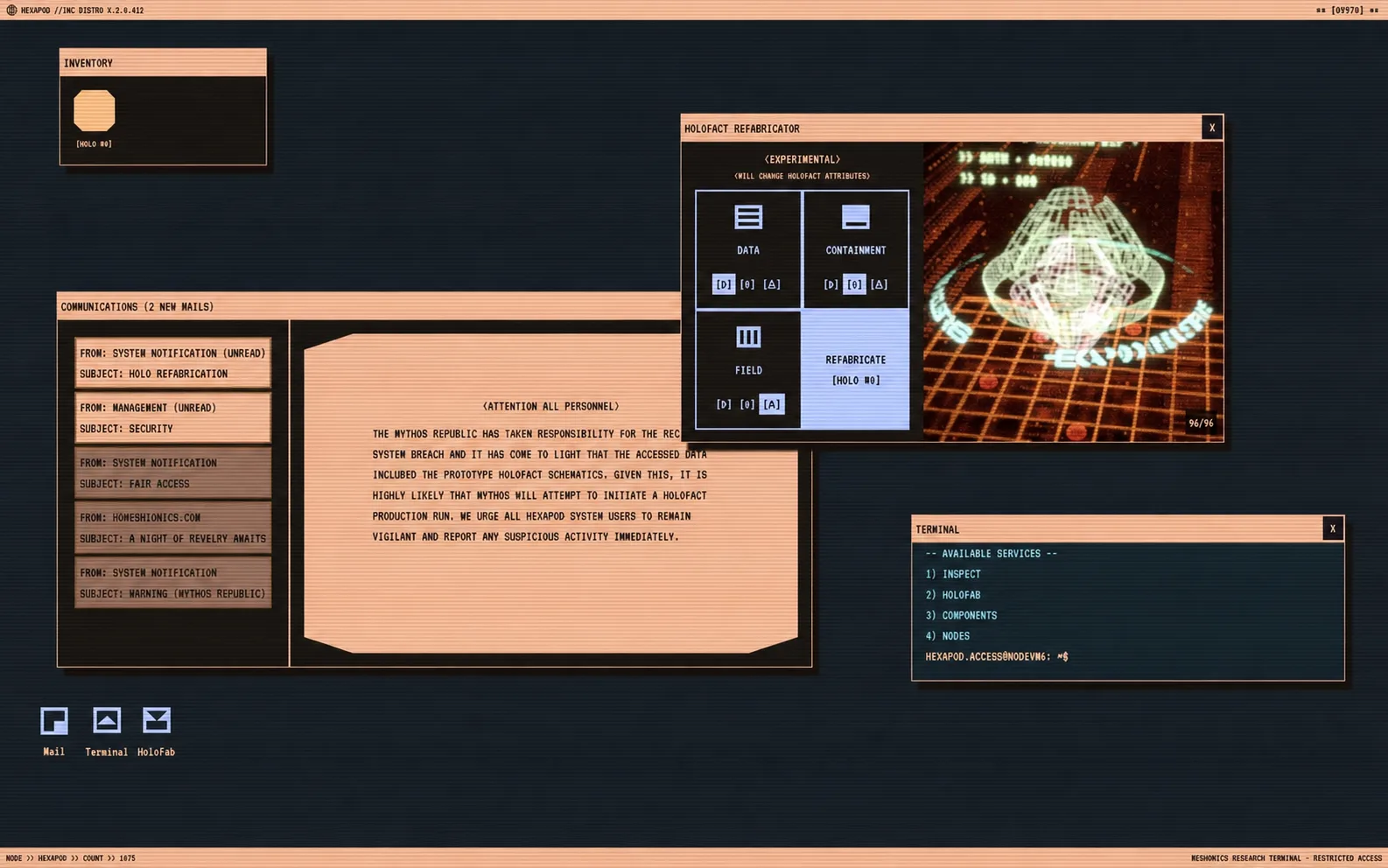
The first way into the story: a research terminal that asked visitors to investigate before they could take part.
INSIDE THE STORY
Players read messages, discovered terminal commands and found a hidden “bind” operation. A five-minute trial turned access to a Holofact into something to work out. Missing the mint window “burned” that wallet’s access to the trial.
DESIGNED & BUILT
An amber-and-ink faux desktop with layered windows, inboxes and a working terminal. I connected the puzzle flow to mint permissions and built the 3D artifact viewer and hidden REFAB interface.
REFAB let holders change their Holofact’s appearance. It was a cosmetic transformation, not an upgrade in capability.
The original Hexapod form, rendered in the browser.
Use the link below to explore this Holofact.
The original Hexapod form, rendered in the browser.
LIVE RENDERER · NO WALLET REQUIREDOpen original viewer ↗TERMINAL / THE FIRST POINT OF CONTACT
02 / MESHIONICSTHE RESEARCH PORTAL
The clue left the browser.
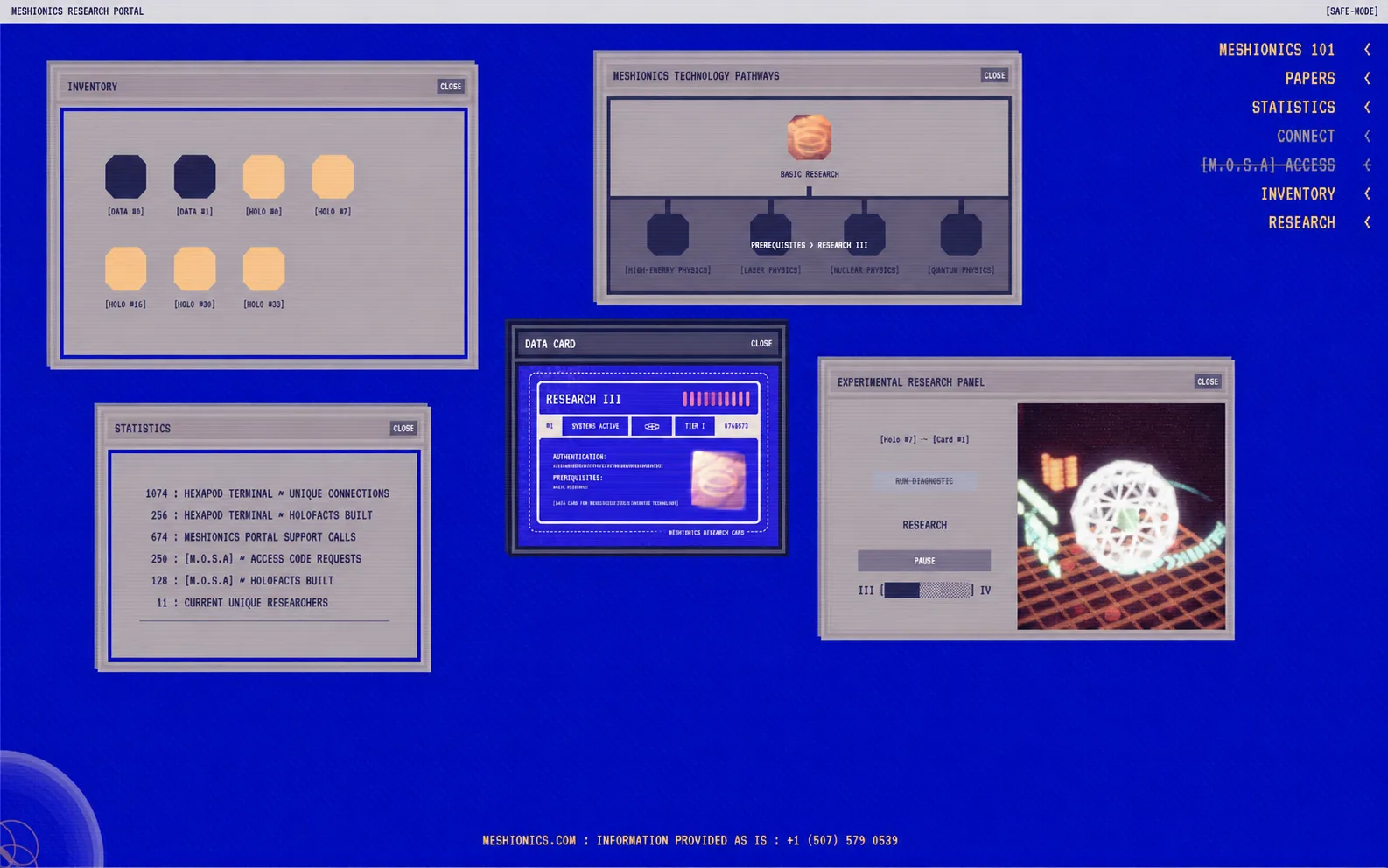
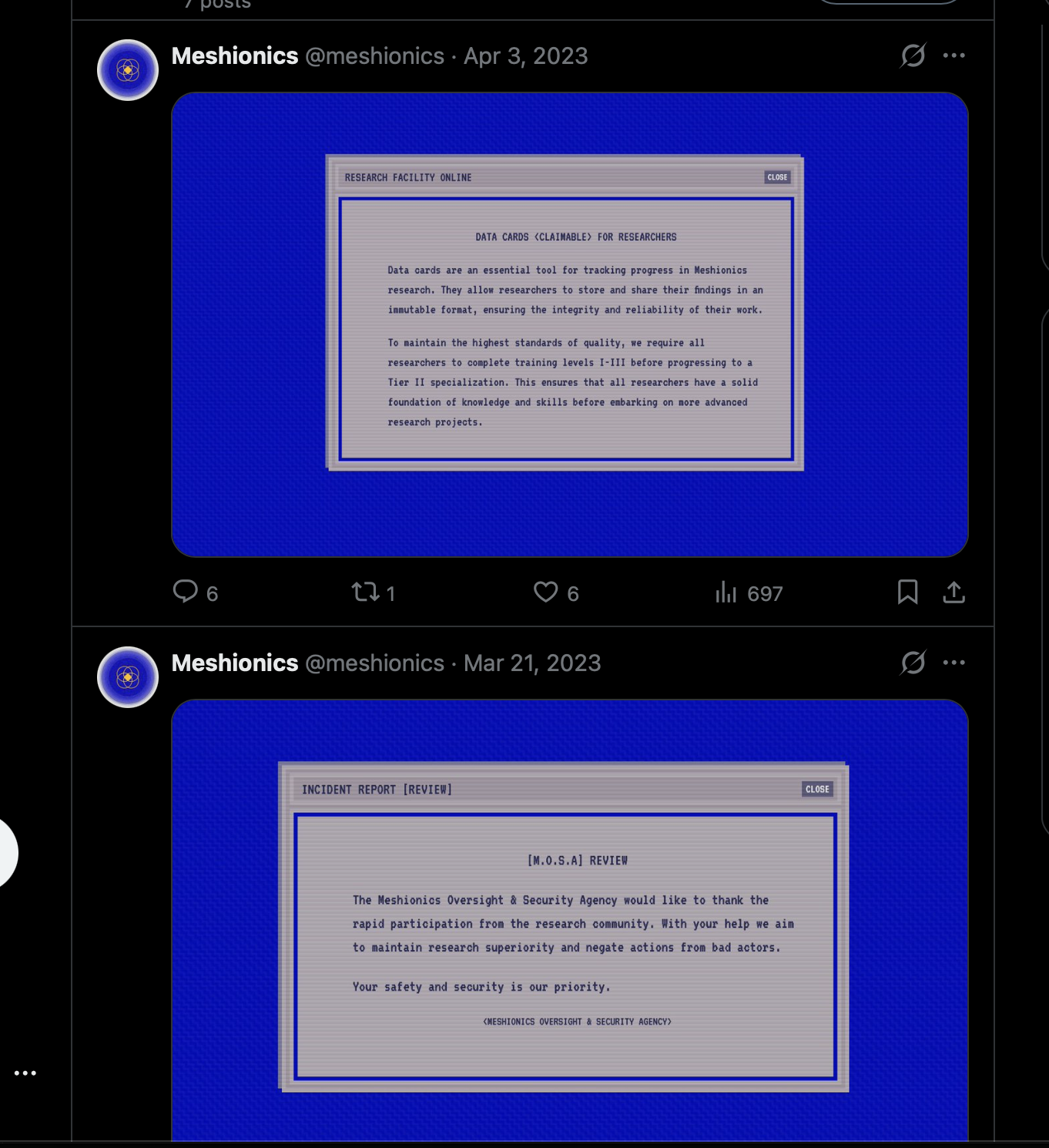
A blue safe-mode research interface hid a route into Mosa, an alternative group working with the same fictional technology.
INSIDE THE STORY
A discreet phone number led to a custom Twilio switchboard. Players followed voice prompts, recovered a code in phonetic alphabet and returned to an admin login to unlock the release.
DESIGNED & BUILT
I paired an electric-blue desktop with grey utility windows, research cards and glowing objects. The web interface and phone-tree logic made a familiar support call part of the puzzle.
ARCHIVE CONTEXT The phone challenge, research cards and levelling system all launched. The later component factory and wider reconstruction plans remained unfinished.
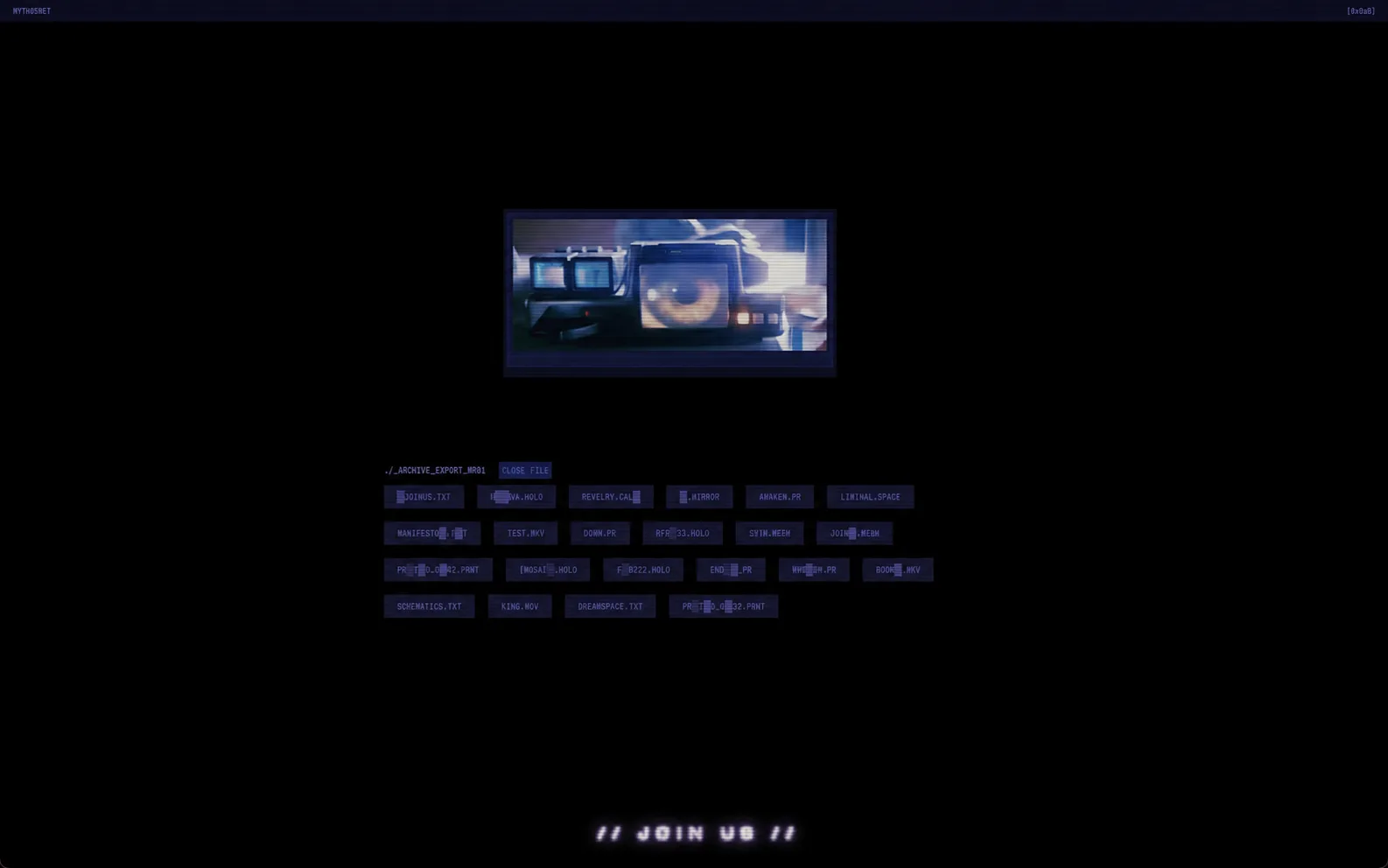
Mythos challenged the corporation’s control. Its website traded administrative order for hidden files, fragmented media and an invitation to join.
INSIDE THE STORY
Propaganda appeared on Hexapod’s corporate website. A clue in its source code pointed to Myth05, where a cryptic initiation quiz used movie quotes and references hidden across the site. Passing it unlocked the extraction of stolen prototypes, released in three variants.
DESIGNED & BUILT
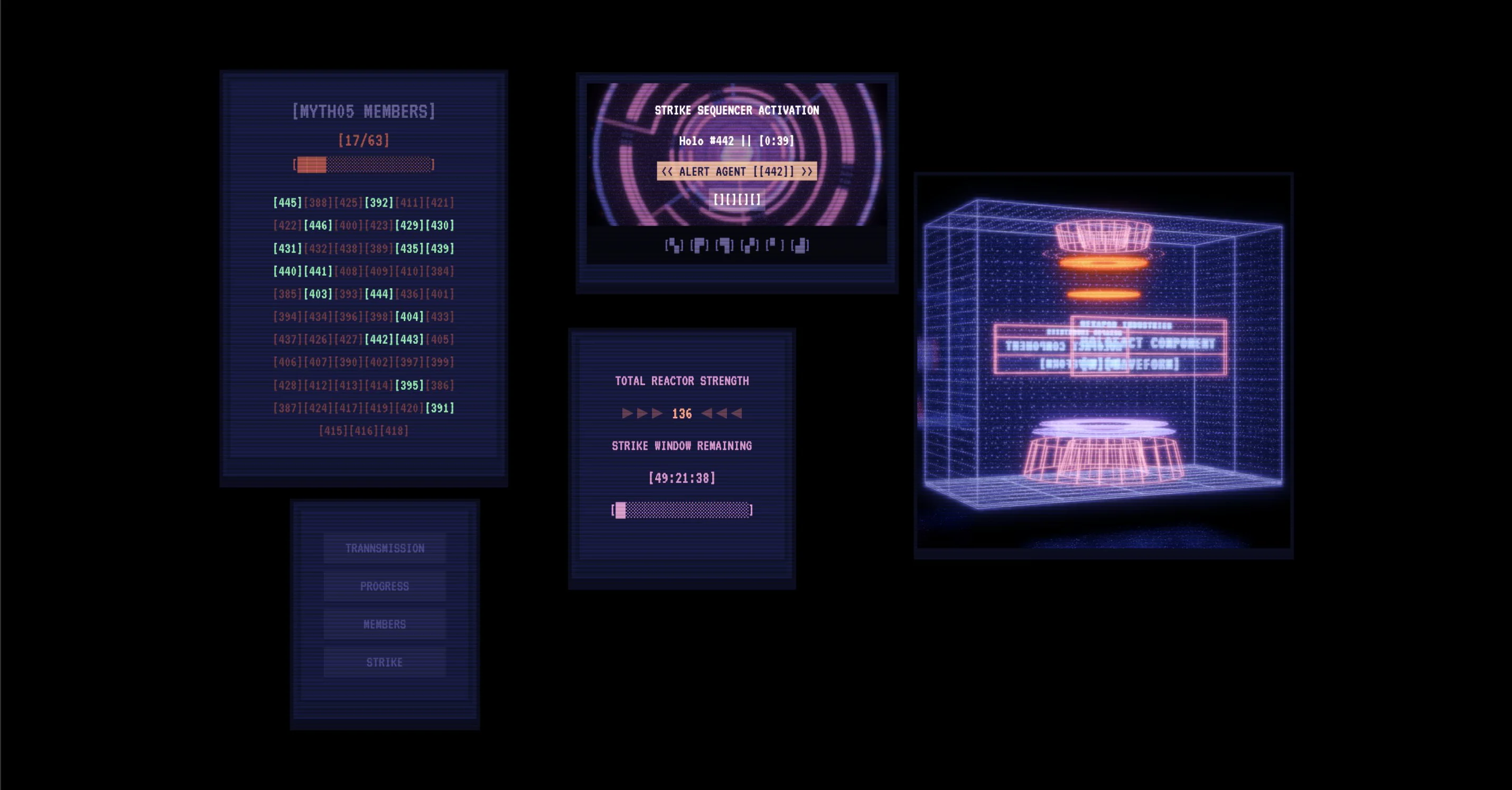
I built the dark archive, concealed file interactions and recruitment flow, with violet type and isolated video fragments. I also built the collaborative sequencer used in the later faction event.
RELEASE STATUS Recruitment, prototype extraction and the community event went live. Players coordinated through the sequencer and chose a direction for the network. The intended continuation into a component factory remained unfinished.
LIVE RENDERER · NO WALLET REQUIREDOpen original viewer ↗STRIKE SEQUENCER / COMMUNITY EVENT
04 / HOLOFACTS & SYSTEMSBEHIND THE FICTION
Objects with a memory.
Holofacts were digital collectibles presented as strange research artifacts. The interfaces gave them a place in the world. Each was an ERC-721 token on Ethereum: a uniquely identified collectible whose ownership could be checked by any of the faction sites.
REFAB / Holo #2
ORIGINAL 3D ARTIFACT
A refabricated Hexapod Holofact. The original renderer selects its field, data and containment variants from the REFAB configuration.
Use the link below to explore this Holofact.
A refabricated Hexapod Holofact. The original renderer selects its field, data and containment variants from the REFAB configuration.
The websites checked puzzle completion and issued a signed authorization. A player submitted that signature with their wallet transaction; the Solidity contract checked it before creating the Holofact. The contract enforced release limits and one mint per address within each group.
02
CODE → OBJECT
React Three Fiber rendered the glowing, animated Holofacts inside the browser. Faction-specific forms and surfaces made the same underlying technology feel different in each setting.
03
OWNERSHIP → TRANSFORMATION
The released REFAB interaction changed an artifact’s visual design. Later component crafting and reconstruction work explored deeper manipulation, but did not ship as complete player-facing systems.
WHAT RAN WHERE
Browser
React and Next.js ran the desktops, files and terminal interactions. React Three Fiber rendered the Holofacts; wallet connections let the sites check which artifacts a player held.
Application services
Next.js API routes handled challenge checks and signatures. Supabase stored off-chain state such as timed access, phone authorization codes and REFAB choices. Twilio delivered the voice menu and spoken codes.
Ethereum
Solidity contracts recorded Holofact ownership and controlled issuance. Alchemy connected the applications to Ethereum; Hardhat supported contract testing and deployment scripts.
The whole game was not stored on-chain. The story, graphics and puzzle state lived in the applications and their services. Blockchain ownership let the separate sites recognise the same collectible.
REHEARSING THE SYSTEM
The interfaces depended on rules that had to hold up beyond the screen: who could mint, how research accumulated and whose action counted in a shared event. The surviving code records how I approached those problems.
A release at capacity
The local Hardhat setup generated 300 funded test wallets. A mint-limit test filled all 240 public places, then checked that the next mint was rejected. Other tests covered repeat minting, reserves and burning. Separate network configurations supported testnet and mainnet deployment.
Time on fast-forward
Research experiments used mock contracts and advanced the local blockchain in batches of blocks. The scripts started, stopped and restarted research, making it possible to inspect accumulated progress without waiting through the intended research period.
A shared turn
The Mythos strike connected wallet signatures, Alchemy ownership checks and Supabase game state. Its action endpoint checked the participant, their turn and the current sequence before recording success and choosing the next agent. The coordination lived in the application; each turn did not require a blockchain transaction.
The original releases used Ethereum wallets and transactions. This retrospective is open to everyone and does not require a wallet.
05 / SEQUENCE & MAKINGDESIGN × ENGINEERING
How the release unfolded.
A five-minute terminal trial grew into three connected websites, evolving artifacts and a shared community event. I designed and built each release as the story unfolded.
THE RELEASE SEQUENCE
SEVEN STAGES / ONE STORY
01ACCESS
STAGE 01 / 07
01 / ACCESS
Five minutes to find a way in.
Players entered with a wallet, found the terminal and worked out how to mint a Holofact before the five-minute window closed. If time ran out, that wallet’s access was “burned”: it could no longer take the trial. This was the strongest launch of the project.
The Meshionics Research Portal introduced Mosa and a different version of events. Its blue desktop concealed a phone challenge: call the switchboard, recover a spoken code and return to the website to unlock access.
SIDE CHANNEL An email to H ↗
An address hidden in the in-world inbox, h@meshionics.com, offered another route out of the websites: contacting H directly.
My notes record players following that lead. Its connection to a possible fourth faction remains uncertain, and no completed fourth release is documented.
Back inside Hexapod, REFAB let holders change the appearance of their Holofacts. The collectible became something to operate and reshape inside the fictional desktop.
Research cards and levelling launched in Meshionics. Players could claim a Data Card and progress through research levels, giving them a reason to return beyond the initial puzzle and mint.
Mythos propaganda interrupted the Hexapod website while the faction accounts played out the attack on Twitter. Looking in the site’s source code revealed a “pwned by Mythos” clue and a route to the new Myth05 website.
Mythos released three versions of the prototypes it had stolen. A cryptic initiation quiz gated the extraction: players pieced together answers from movie quotes, references and clues embedded in the website.
07 / SEQUENCER
The sequencer, and where it stopped.
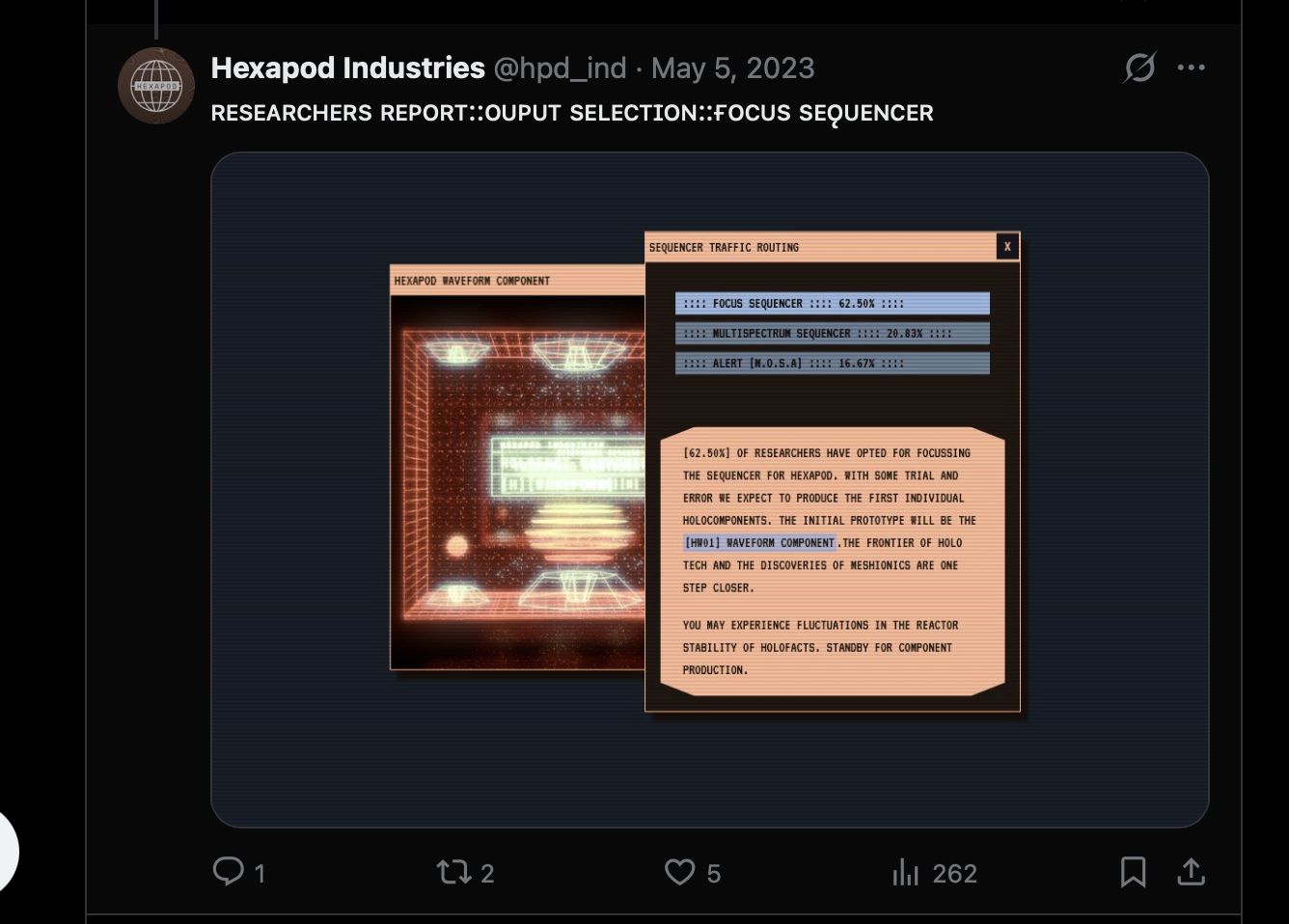
A community event asked players to work together to bring the sequencer online. The shared interactions ran, and players helped choose what the network should do next.
WHERE SHOULD THE SIGNAL GO?
Focus the sequencer for Hexapod
Try multispectrum sequencing
Alert Mosa
The recorded vote favoured Hexapod. A research update announced the first waveform component as the next intended output.
Coordination and interface problems limited the event. The planned continuation—a component factory where players could build with the artifacts—never materialised, and the project lost momentum.
Warm corporate terminals, a blue research desktop and a sparse underground archive. Each interface expressed a different point of view while sharing the same story and artifacts.
THE INTERFACE WAS THE PUZZLE
Inbox messages, hidden commands and a real phone tree made familiar software behaviours into narrative devices. Players learned about the world by operating it.
Released, then left open. The 12-week release ended after the community event. Shared interactions, research cards and levelling had shipped; the component factory, reconstruction systems and later physical-media ideas stayed unfinished.
The lesson: a smaller sequence of complete interactions would have served the story better than an expanding set of systems.
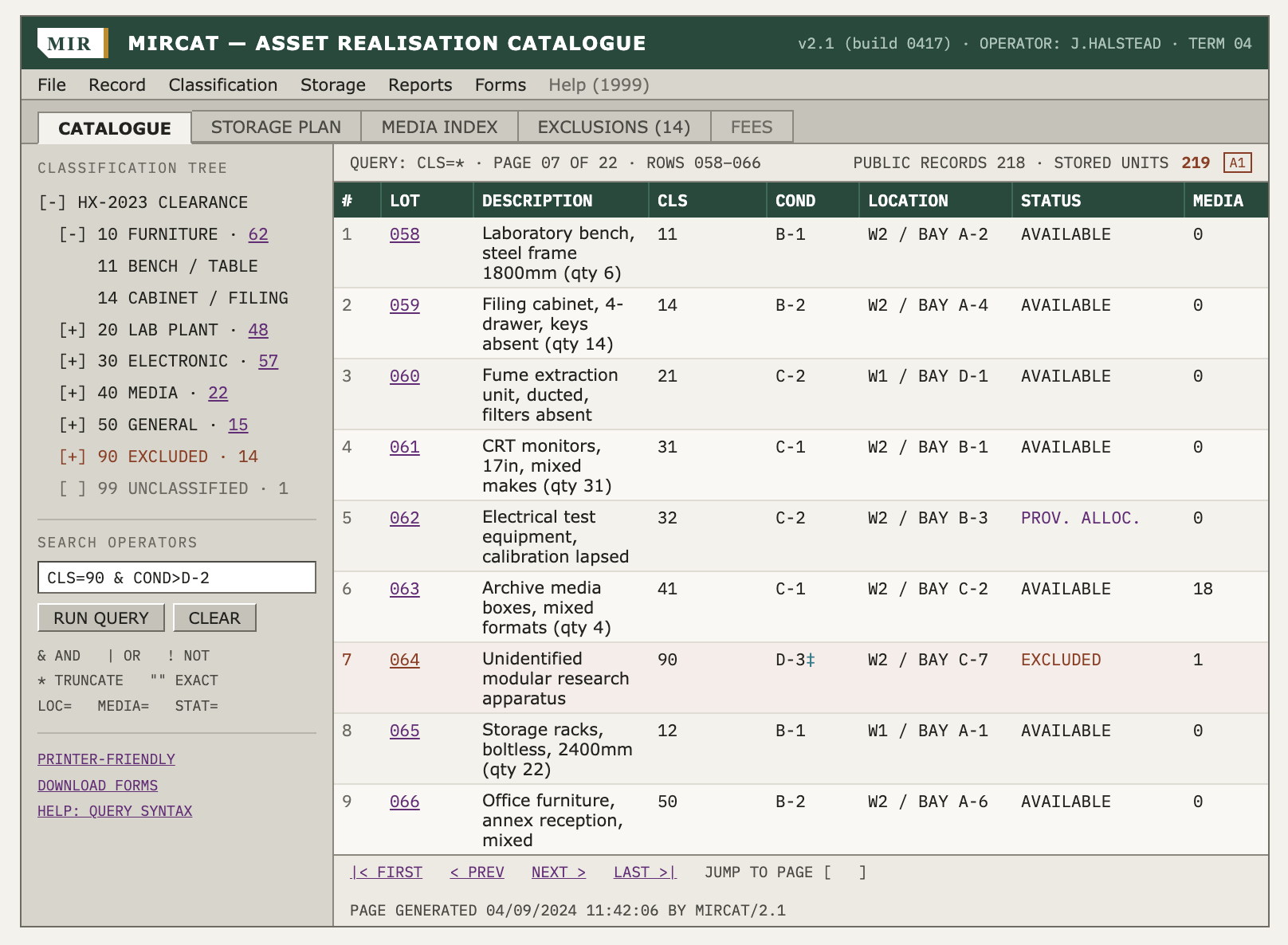
The planned second season begins after Hexapod’s collapse. Morrow Industrial Recovery, a fictional liquidator, is cataloguing what remains: laboratory equipment, damaged apparatus and overlooked recovery media. The inventory becomes a new way into the story.
MORROW INDUSTRIAL RECOVERY
A closure notice would lead players into an ordinary-looking disposal catalogue. Lot descriptions, condition reports and warehouse inspection views offer fragments to compare. The invitation is to notice what does not quite belong, then follow it.
I’m exploring a quieter visual language for this chapter: administrative typography, inventory numbers, blunt condition notes and unglamorous equipment photographs. Familiar record-keeping becomes the interface for discovery.
The recovery story extends beyond the catalogue into a physical edition of floppy disks. Receiving, examining and sharing an object becomes part of investigating what Hexapod left behind.
64
PHYSICAL FLOPPY DISKS
A finite edition of objects to receive, inspect and investigate.
PHYSICAL ARCHIVE / 01
Photographs of the floppy disks to be added.
+
01 / THE PHYSICAL EDITIONPHOTO TO FOLLOW
PHYSICAL ARCHIVE / 02+
Label & surface details
02 / UP CLOSEPHOTO TO FOLLOW
PHYSICAL ARCHIVE / 03+
Making the physical edition
03 / THE PROCESSPHOTO TO FOLLOW
WHY A FLOPPY DISK?
The object becomes part of the investigation. The disks are intended to contain a puzzle and surviving fragments of the archive: something to handle, examine and share, with consequences back inside the digital world.
The edition size reflects what I can prepare and send myself. The goal is to make receiving and figuring out the object meaningful in its own right.
WHAT I’M EXPLORING NEXT
01
Reading becomes an interaction.
Catalogue entries, attached reports and remote warehouse inspection could reveal different parts of the same record. The challenge is to make close observation rewarding while keeping the administrative interface believable.
02
A shared recovery.
Clues would connect the catalogue, social accounts and physical disks. Newcomers could begin investigating without a Season 1 artifact, while returning holders bring a history with the world. Shared discoveries should help the story progress beyond the people who receive a disk.
03
Damage with consequences.
Damaged Holofacts provide a route back to the unfinished component system. I’m exploring how taking an artifact apart and rebuilding it could leave a visible history of changes, extending the cosmetic REFAB experiment into decisions with lasting consequences.
A CONTINUATION IN DEVELOPMENT
The physical edition size is decided. The disk puzzle’s payoff, reconstruction rules and the season’s ending are still being designed. These are plans for the continuation, separate from the completed 12-week release.